Exercise after colon cancer treatment: is it worth the cost in Norway?
Results brief, October 2026. André Hartmann, health economist.
These are the results of the cost-effectiveness model built for my master's thesis in the European Master in Health Economics and Management, defended in August 2026.
The answer in three lines
- A three-year structured exercise programme after surgery and chemotherapy for colon cancer gives patients more healthy life at a modest extra cost.
- Over a lifetime the programme costs 33,447 NOK more per patient and adds 0.913 quality-adjusted life-years (QALYs). One QALY is one year of life in full health.
- That is 36,644 NOK per QALY gained. The threshold this analysis applies is 385,000 NOK per QALY, so the programme is cost-effective by a wide margin.
The evidence: the CHALLENGE trial
The clinical effect comes from one randomised trial, CHALLENGE (Courneya et al., New England Journal of Medicine 2025;393:13-25).
The trial assigned 889 patients at 55 centres to a three-year structured exercise programme or to health-education materials alone. All had completed surgery and adjuvant chemotherapy for stage III or high-risk stage II colon cancer.
The median follow-up was 7.9 years. A hazard ratio below 1 means fewer events in the exercise group.
| Outcome | Exercise | Health education | Hazard ratio over the whole follow-up (95% confidence interval) |
|---|---|---|---|
| Disease-free survival, share at 5 years | 80.3% | 73.9% | 0.72 (0.55 to 0.94) |
| Overall survival, share at 8 years | 90.3% | 83.2% | 0.63 (0.43 to 0.94) |
The model
The model asks what the programme would cost and gain if it were offered to Norwegian patients.
- It is a partitioned survival model with three health states. In plain words: it follows a group of patients month by month and counts how many are disease-free, how many have progressed disease, and how many have died.
- The group starts at age 61, the median age in the trial, and is followed for 40 years.
- Lognormal curves are fitted to the published survival curves of the health-education group and used for the whole period, including the years beyond the trial. The exercise group's curves follow from them through the trial's hazard ratios. Mortality is never allowed to fall below that of the general population (Statistics Norway table 07902).
- The base case keeps the trial's treatment effect constant over the whole period. Scenarios test an effect that fades.
- Costs are in 2024 NOK, with the July 2025 Helfo tariffs and the 2026 patient-travel rate at face value. The extended healthcare perspective counts the programme, follow-up, treatment of progressed disease and terminal care, and also the patients' travel and time for the exercise sessions.
- Future costs and health effects are discounted at 4 percent a year (Rundskriv R-109).
- The threshold follows the Norwegian severity approach (Magnussen et al. 2015). These patients lose 4.93 QALYs compared with the general population, which places them in severity group 2 with a weight of 1.4. The base threshold of 275,000 NOK per QALY times 1.4 gives 385,000 NOK per QALY.
Results
| Per patient, lifetime | Standard care | Exercise | Difference |
|---|---|---|---|
| Cost, NOK | 491,923 | 525,370 | 33,447 |
| QALYs | 10.243 | 11.156 | 0.913 |
| Life-years, discounted | 1.15 | ||
| Cost per QALY gained, NOK | 36,644 |
The table shows the deterministic result: every input at its central value. The probabilistic analysis repeats the calculation 10,000 times, each time with inputs drawn from their uncertainty ranges. The second table summarises the draws:
| Probabilistic analysis, 10,000 draws | Value |
|---|---|
| Mean extra cost per patient, NOK | 29,883 |
| Mean QALYs gained per patient | 0.886 |
| Cost per QALY gained: mean extra cost divided by mean QALYs gained, NOK | 33,736 |
| Share of draws in which exercise is cost-effective at 385,000 NOK per QALY | 99.3% |
| Share of draws in which exercise is cost-effective at 275,000 NOK per QALY | 97.6% |
How sure is the result?
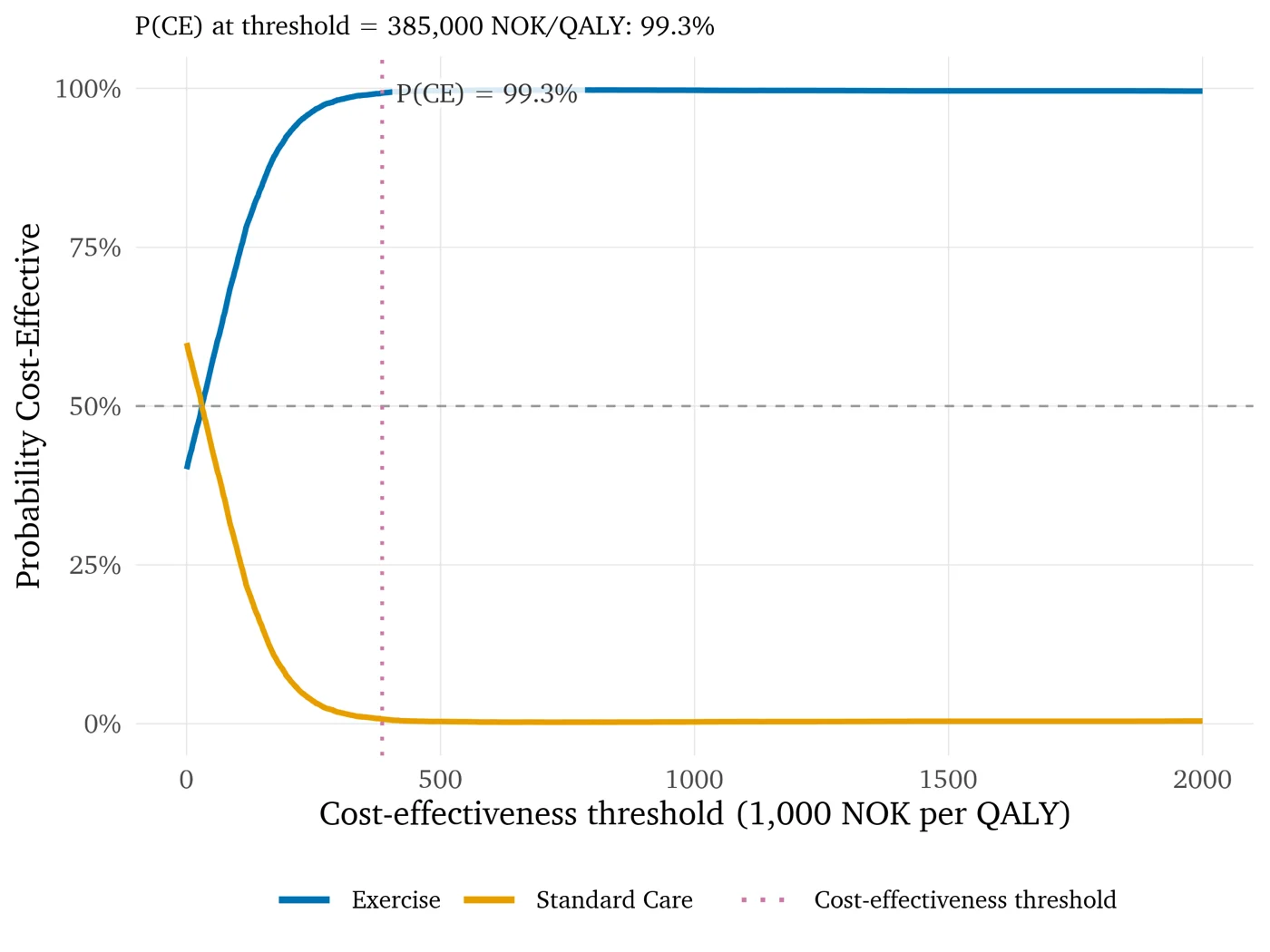
Figure 1 shows the probability that exercise is cost-effective at each threshold.
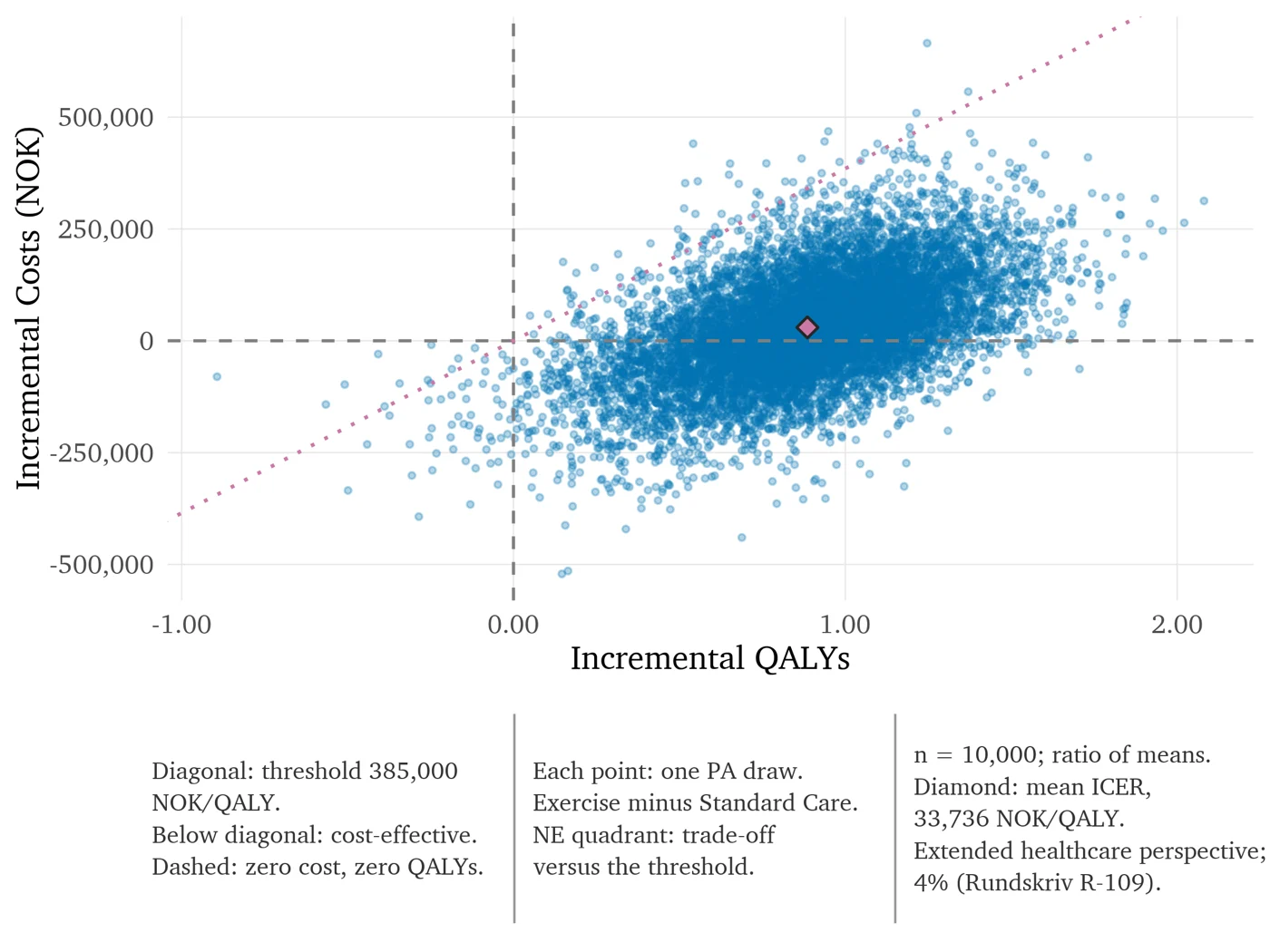
Figure 2 shows every draw. In 39.4 percent of the draws exercise was both more effective and cheaper than standard care.
One-way analysis: eight inputs were each moved to a lower and an upper bound in turn. The two hazard ratios from the trial moved the result most. The probability of being cost-effective never fell below 97.0 percent.
Scenarios: 25 alternative scenarios were run. One of them removes the general-population mortality limit and is designed to fail, which it does. In the other 24 the programme stayed cost-effective at the threshold of each scenario.
- The highest cost per QALY was 90,240 NOK, when every patient attends all 60 sessions.
- In 6 scenarios the programme was cheaper and more effective than standard care. Among them are the two scenarios where the treatment effect fades.
- The health gain depends on age. For a group starting at age 74 the gain shrinks to 0.050 QALYs per patient.
What this analysis cannot tell you
- The effect rests on a single trial. The model assumes the same effect in Norwegian patients.
- Survival beyond the trial period is an extrapolation, not an observation.
- Norwegian colon cancer patients are older than the trial patients, and the health gain is smaller at higher ages.
Sources
- Courneya KS, et al. Structured Exercise after Adjuvant Chemotherapy for Colon Cancer. N Engl J Med 2025;393:13-25. https://doi.org/10.1056/NEJMoa2502760
- Magnussen J, et al. 2015, Table 3 (severity groups and weights).
- Finansdepartementet. Rundskriv R-109 (discount rate).
- Statistics Norway, table 07902 (life tables).
These are corrected results. Three input values were known to differ from the trial publication when the thesis was defended: the numbers at risk in the health-education group's overall-survival curve at 60, 96 and 108 months. The thesis as examined carries the earlier values. The conclusion is unchanged.