André Hartmann
Health economist with ten years' experience as a healthcare professional.
See my model results brief and my independent resource-criterion article.
I work in market access, getting new treatments funded, and in health technology assessment (HTA). HTA is the appraisal Norway uses before deciding what the health service pays for. I also work in project management, and in safe, practical use of AI.
- 10
- years as a healthcare professional
- EU-HEM
- master's in health economics and management
- HEOR
- health economics and outcomes research, that is, what treatments cost and what they achieve for patients
- Responsible AI
- AI answers checked against their sources
Available now · Oslo · ready to relocate worldwide LinkedIn

Three examples of my work
-
Economic model: exercise after colon cancer
Is a structured exercise programme after colon cancer treatment worth its cost in Norway?
For my master's thesis I built a cost-effectiveness model in R, a programming language for statistics. The model weighs what the programme costs against the health it gives patients.
The results brief gives the answer in plain language, how sure it is, and what the analysis cannot tell you.
Read the results brief -
Project delivery: staff time in priority-setting
How could Norway count the staff time a new treatment needs when it decides which treatments to fund (the resource criterion)?
As a market access intern at Roche Norge, I was in a team of three and managed the project week by week. I did all the interviews with academics and a decision-maker. I also proposed a traffic light framework for healthcare staff shortages, which the team built into its final method.
The work reached decision-makers. The Ministry of Health and Care Services invited the team to present at an expert group meeting, and I presented the findings.
Read my analysis of the resource criterion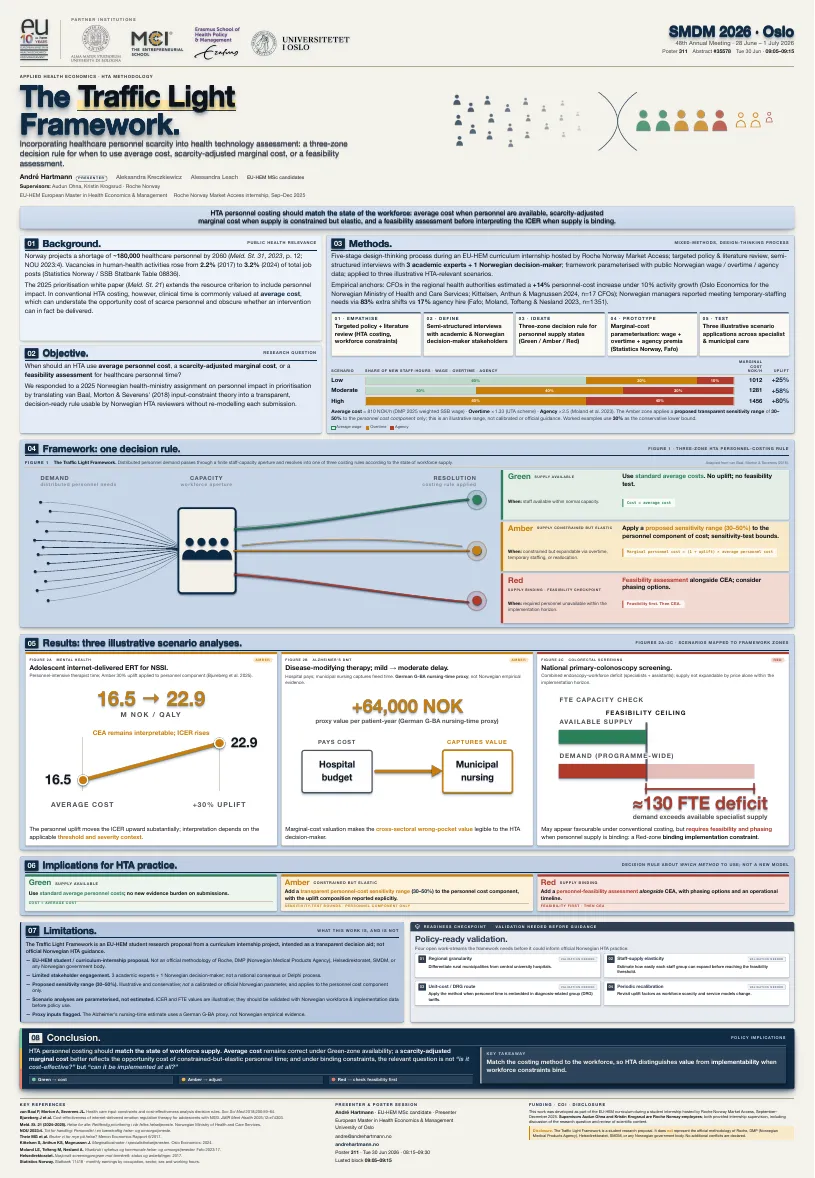
Poster presented at SMDM 2026 (the annual meeting of the Society for Medical Decision Making), Oslo, 30 June 2026. Finalist for the Lee B. Lusted Student Prize, a student prize at that meeting (PDF, 6.6 MB). -
AI implementation: one department at a time
How can AI help with daily work in a company that must follow strict rules, without weakening trust in the answers?
As internal AI Coach at Roche Norge, I built ways of working with AI for every department on the pharmaceutical side. I taught one department at a time and built a check that AI answers match their sources.
The case shows my rule for AI: check every answer against its source and leave the final judgement to people.
Read the AI implementation case
Technology becomes valuable when it fits the work, responsibility, and decisions it is meant to support.
Get in touch
I would like to discuss roles and project work in digital health, responsible AI, HEOR and market access. I am also interested in public-sector appraisal, which means weighing options before a public decision, and in putting research into practice.